
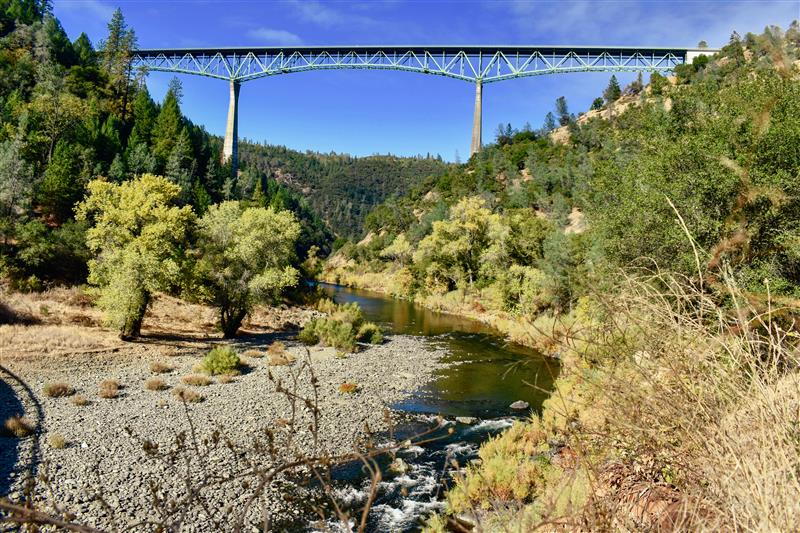
What it takes to inspect 288 welds, 730 feet in the air.
A Bridge Between Past and Future
Stretching 2,428 feet across the American River canyon, the Foresthill Bridge is the tallest bridge in California and the fourth highest in the United States. It’s a local landmark where generations have left their stamp, a backdrop to daily life and even a piece of film history.
In 2024, this 50-year-old structure became the focus of a federally funded initiative to assess bridges built with T-1 steel — a mid-century material associated with emerging safety concerns. Constructed in 1973 with 288 fracture-critical butt welds, Foresthill was selected for comprehensive non-destructive testing as part of a national program.
The challenge: inspect every weld on one of the country’s tallest bridges while keeping traffic safely moving.
An Inspection Unlike Any Other
Placer County selected Atlas to lead the inspection based on our proven performance on high-risk, high-profile projects, including the San Francisco-Oakland Bay Bridge and the I-10 Freeway fire response.
The team developed and executed a plan to inspect every weld using a combination of suspended snooper trucks, custom-engineered access platforms and advanced ultrasonic testing methods, with inspections performed at heights exceeding 700 feet.
The work required:
- Operating sensitive equipment in extreme height and weather conditions.
- Maintaining American Welding Society (AWS) D1.5 Bridge Welding Code compliance.
- Coordinating with Caltrans Materials Engineering and Testing Services and Federal Highway Administration (FHWA) oversight teams.
- Ensuring crew safety through 18+ rain-impacted days.
“Every weld we inspect carries the weight of public trust. Our job is to evaluate thoroughly and report clearly, so our clients can make informed decisions that support safer infrastructure for the communities they serve.” –Aaron Prchlik, PE, Project Manager.
When Scope Expands, Execution Matters
The original plan called for a targeted inspection. As work progressed, the defect rate became significantly higher than the initially anticipated. Several welds required immediate metallurgical review due to surface-breaking cracks.
Atlas responded in real time by:
- Increasing ultrasonic testing to achieve full defect coverage.
- Adapting scanning techniques for obstructed weld locations.
- Providing timely data to support emergency repair decisions.
- Maintaining detailed documentation throughout the expanded scope.
Results That Reached Beyond Placer County
The inspection protocols, findings and repair recommendations developed through this project are helping inform FHWA guidance for evaluating T-1 steel bridges across the country. The project contributes to a shift in national conversation from reactive maintenance to proactive infrastructure protection.
Key Outcomes:
288
welds tested using non-destructive methods
0
safety incidents during months of elevated operations
100%
compliance with inspection and reporting requirements
44
repairs successfully completed
A Legacy Maintained
Today, the Foresthill Bridge continues to carry more than 50,000 daily travelers, standing not only as an engineering achievement but also as a structure maintained through decades of partnership and public investment.
The inspection effort highlights the importance of collaboration among agencies, engineers, and inspectors. Through strategic planning and coordinated execution, the project advanced immediate safety goals and contributed to a deeper understanding of the conditions of T-1 steel bridges nationwide.